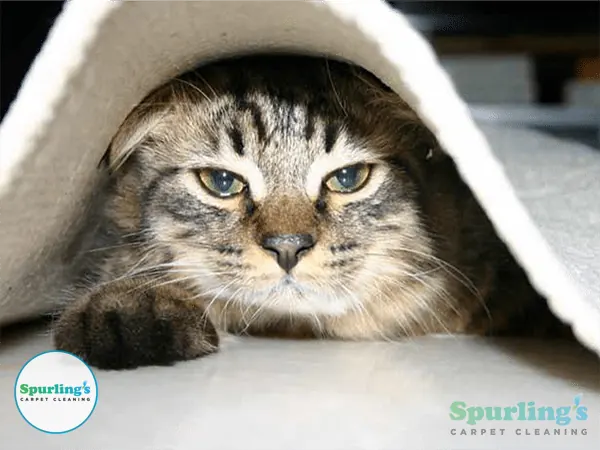
If you have pets, you know the problem all too well: that persistent smell that clings to your carpet no matter how many times you spray, blot, or shampoo. Pet odor removal from carpet is one of the most requested services at Spurling’s Carpet Cleaning — and for good reason. Pet urine doesn’t just sit on the surface. It soaks deep into the carpet fibers, the backing, and even the subfloor, where it crystallizes and continues releasing odor every time it gets warm or damp.
Pet owners in Rochester and the surrounding region, including Monroe County (Greece, Irondequoit, Webster, Penfield, Fairport, Henrietta, Brighton, Pittsford, Gates, Chili, Spencerport, Churchville), Ontario County (Canandaigua, Victor, Farmington, Manchester, Geneva), Wayne County (Macedon, Palmyra, Newark, Williamson), Livingston County (Geneseo, Avon, Livonia, Caledonia, Lima), and Seneca County (Seneca Falls, Waterloo)
Why Pet Odors Are So Hard to Remove from Carpet
Urine from cats and dogs contains uric acid crystals that bond tightly to carpet fibers. When the crystals dry, the smell seems to disappear — until humidity rises, the room gets warm, or the spot gets wet again. That’s why a carpet that smells “fine” in winter can reek in summer.
Most over-the-counter odor removers only mask the smell or break down a small portion of the uric acid on the surface. They can’t penetrate deep enough to reach the crystals that have migrated into the carpet pad and subfloor — which is where the real problem lives.
The Spurling’s Pet Odor Removal Process
Spurling’s uses a professional-grade, hot water extraction system with truck-mounted equipment that generates far more heat and suction than any rental machine. Our odor treatment process includes:
- Urine detection: We identify every affected area, including spots that aren’t visible to the eye, using UV inspection and moisture readings.
- Pre-treatment: We apply a professional enzyme treatment specifically formulated to break down uric acid crystals at the molecular level — not just on the surface.
- Deep hot water extraction: Our truck-mounted system flushes the treatment deep into the carpet pile and backing, then extracts it along with the dissolved odor compounds and residue.
- Odor neutralizer: A final rinse with a pH-balanced odor neutralizer leaves your carpet smelling clean — not just masked with fragrance.
In severe cases where urine has soaked through to the subfloor, treatment from above may not fully solve the problem, and a flooring repair may be needed. That repair is outside the services we provide. We’ll always give you an honest assessment before we start — no surprises.
What to Expect from Professional Pet Odor Treatment
Spurling’s uses professional-grade enzyme treatments combined with hot water extraction that penetrate far deeper than anything available for home use. Results depend on how deep the urine has soaked, how long the contamination has been present, and whether the subfloor underneath is affected. We always give you an honest assessment before we start — no surprises.
Does Professional Carpet Cleaning Remove 100% of Pet Odors?
Often, yes. Professional treatment resolves most pet odor cases when the contamination hasn’t reached the pad or subfloor. For older or repeated accidents, full removal may require pad replacement or subfloor sealing — something we’ll assess and explain honestly before any work begins. Please note: pet-related issues (urine, vomit, diarrhea, blood, and similar) are excluded from our 100% Money Back Guarantee and No Reappearing Spot Guarantee.
Many customers are amazed that their carpets don’t just smell better — they look better too, because the same deep cleaning that removes odor also removes the dirt and residue the urine left behind.
Serving Pet Owners Across Monroe, Ontario, Wayne, Livingston & Seneca Counties
Spurling’s Carpet Cleaning has been treating pet odors in carpets across the Rochester metro area since 1999. We’re a local, family-run business with over 35 years of cleaning experience — we understand pet owners because many of us are pet owners too. We use safe, non-toxic cleaning solutions that are gentle for your kids and pets once dry.
Whether it’s a single accident spot or a whole room of deep-set odor, we have the equipment and the expertise to get it out. Learn more about our stain, urine, and odor removal services — or read about how professional odor removal compares to DIY methods in our article Odor Removal Carpet Cleaning: Professional vs. DIY Results.
Ready for Pet Odor Removal from Carpet in Rochester, NY?
Call Spurling’s Carpet Cleaning for a free estimate. We serve Rochester and the surrounding region, including Monroe County (Greece, Irondequoit, Webster, Penfield, Fairport, Henrietta, Brighton, Pittsford, Gates, Chili, Churchville), Ontario County (Canandaigua, Victor, Farmington, Manchester, Geneva), Wayne County (Macedon, Palmyra, Newark, Williamson), Livingston County (Geneseo, Avon, Livonia, Caledonia, Lima), and Seneca County (Seneca Falls, Waterloo)
Looking for pet odor removal from carpet near you? Read what customers say on our Better Business Bureau profile and on our testimonials page. Our pet odor removal from carpet starts with a free estimate, so call 585-955-6300.



1 Comment