
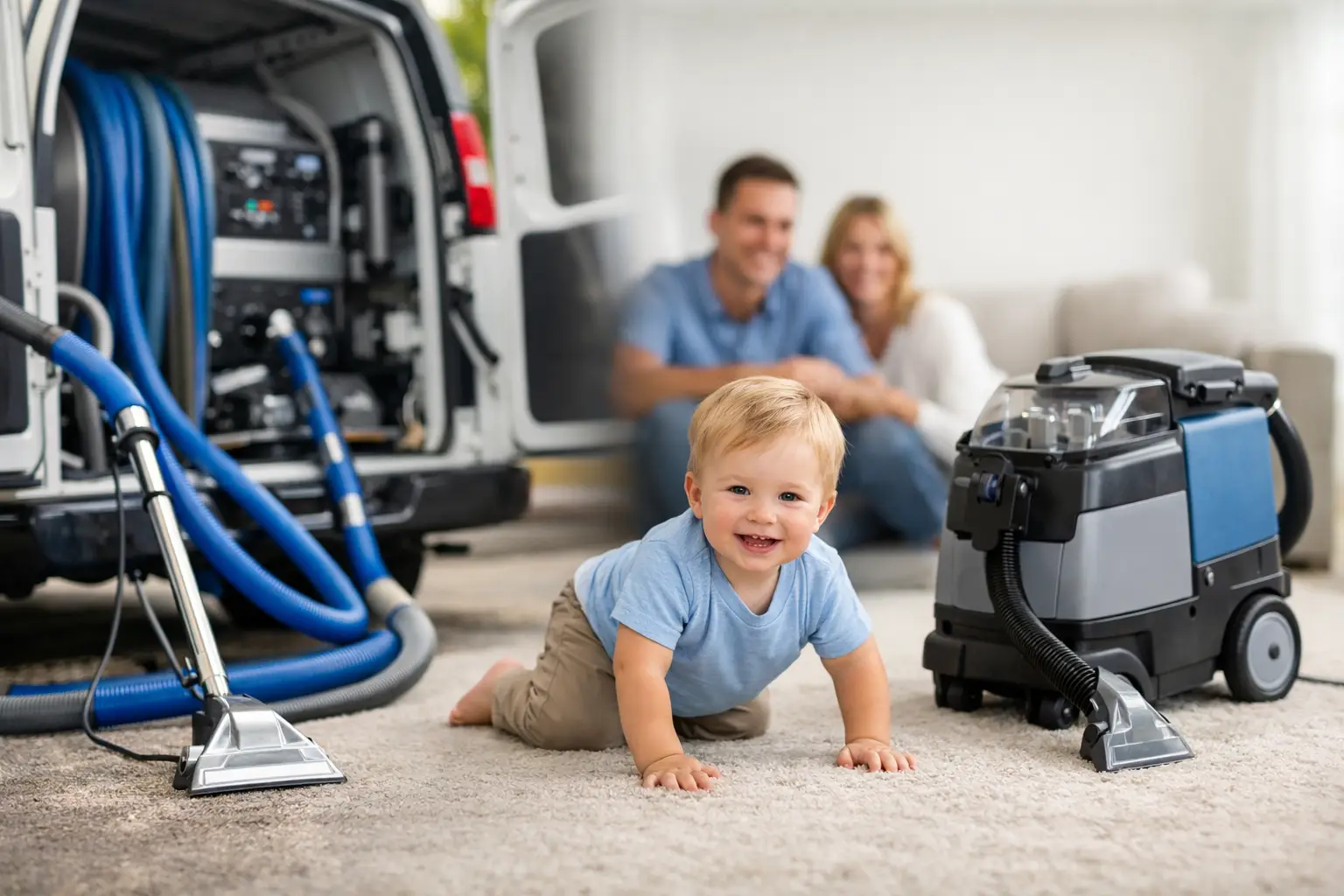
A carpet can look clean immediately after almost any professional appointment. The real test comes later: how quickly it dries, whether traffic lanes stay brighter, whether pet odors return, and whether spots wick back to the surface. That is why truck mounted vs portable extractors is more than an equipment debate. It is a meaningful difference in the cleaning power available in your home or business.
For homeowners and property managers who have been disappointed by damp carpets, returning spots, or a quick surface-level cleaning, the machine behind the service matters. It is not the only factor – technician training, cleaning solutions, and proper preparation all count – but equipment sets the ceiling for what a cleaning system can accomplish.
Truck Mounted vs Portable Extractors: The Core Difference
Both truck-mounted and portable extractors use hot water extraction, often called steam cleaning. In a proper cleaning process, a technician applies a cleaning solution, works it into the carpet as needed, rinses with heated water, and extracts the loosened soil, moisture, and residue. The difference is where the power comes from.
A truck-mounted extractor remains in the service vehicle. Long hoses run from the truck into the property, delivering heated cleaning solution and carrying the recovered water back out to the vehicle. The unit is powered by its own engine or a dedicated system, rather than relying on a household electrical outlet.
A portable extractor is a self-contained machine brought inside. It typically plugs into electrical outlets and holds both clean and recovered water in onboard tanks. Portable units can produce good results in the right circumstances, particularly in areas a truck-mounted hose cannot reach. But they usually have less heat, vacuum lift, airflow, and water capacity than a quality truck-mounted system.
That difference becomes especially noticeable in heavily used carpet, homes with pets, commercial hallways, large rooms, and situations where faster drying is a priority.
Why Strong Extraction Produces a Longer-Lasting Clean
The goal is not simply to make carpet wet and then remove some of the water. The goal is to suspend and remove embedded soil, oils, allergens, residues, and odor-causing contaminants without leaving excessive moisture behind.
A truck-mounted system generally delivers higher water temperatures and more consistent vacuum power. Heat helps cleaning solutions work more effectively on oily soil and stubborn buildup. Strong vacuum then pulls more of the rinse water and suspended soil from the carpet fibers.
This matters because leftover residue attracts new dirt. Incomplete extraction can also leave more moisture in the backing and padding, which can extend dry times and create conditions that are less than ideal for a healthy indoor environment. A carpet should not feel soaked for the rest of the day after a routine professional cleaning.
At Spurling’s Carpet Cleaning, truck-mounted hot water extraction is part of a multi-step approach designed for Thee Longest-Lasting Clean. The equipment is powerful, but the result also depends on taking the time to pre-treat problem areas, rinse thoroughly, and groom the carpet for a more uniform appearance and dry time.
The Benefits of Truck-Mounted Equipment
For most residential and commercial carpet-cleaning appointments, truck-mounted equipment offers a clear performance advantage.
First, it can maintain stronger heat throughout the appointment. Portable machines have a limited amount of heated water available in their solution tanks, and their temperature can drop as work continues. Truck-mounted systems produce heat continuously, helping technicians address more extensive soil without sacrificing cleaning performance room by room.
Second, truck mounts have substantially greater recovery capacity. Instead of filling a small recovery tank that must be emptied repeatedly, wastewater is transferred through the hose to the truck. This supports a more complete rinse and extraction process, especially in larger homes, offices, apartment turnovers, and properties with several carpeted rooms.
Third, the stronger vacuum often means shorter dry times. Drying time still depends on humidity, carpet type, soil level, airflow, and how much moisture was needed to treat the carpet. Still, quality truck-mounted extraction gives a technician a better ability to remove moisture efficiently. Many properly cleaned carpets dry in hours, not days.
Finally, a truck-mounted system keeps much of the operational noise and wastewater outside. There is no portable machine rolling through the home, no need to empty dirty tanks in a customer’s sink or toilet, and less indoor equipment to maneuver around walls and furniture.
When a Portable Extractor Is the Right Tool
Portable equipment is not automatically inferior. It is simply a different tool with limitations that should be understood honestly.
A portable extractor may be necessary when a property is inaccessible to a service vehicle, such as a high-rise office, an apartment far from available parking, or a building with restrictions on running hoses through common areas. It can also be useful for small isolated jobs, upper-floor spaces, and certain upholstery or detail-cleaning applications.
An experienced cleaning company may use a portable unit when logistics require it while adjusting the process to get the best possible outcome. That could mean more dry passes, careful moisture control, added air movement, or a different cleaning method for a delicate textile.
The concern is not that a company owns portable equipment. The concern is when a portable machine is presented as equal to a high-performance truck-mounted system for every job, even when heavy soil, odor treatment, or rapid drying demands more extraction power.
Equipment Alone Does Not Guarantee Great Results
A powerful machine in untrained hands can still produce poor work. Too much cleaning solution, insufficient rinsing, aggressive brushing, or failure to identify fiber type can lead to residue, texture changes, recurring stains, or unnecessary moisture.
The best carpet cleaning combines capable equipment with an educated technician and a clear process. Before cleaning begins, the technician should inspect traffic areas, identify spots, ask about pets and prior treatments, and set realistic expectations. Some stains are permanent color loss or fiber damage, not removable soil. Honest guidance is part of professional service.
Spotting skill matters, too. A dark area near a doorway may be tracked-in soil, while a yellowish pet spot may require an odor and urine treatment beneath the surface. Treating both with the same quick pass is not a solution. The source, fiber, and condition of the carpet guide the treatment plan.
For businesses, the process should also account for foot traffic and scheduling. Cleaning a busy reception area on a Friday afternoon may require faster drying strategies and a plan to keep guests or employees off damp carpet. The right company thinks beyond the machine and respects how the space is used.
Questions to Ask Before Hiring a Carpet Cleaner
You do not need to become an equipment expert before scheduling service. A few direct questions can reveal whether a company is focused on lasting results or simply finishing appointments quickly.
Ask what cleaning method they use, whether they operate a truck-mounted system for accessible properties, and how they manage dry time. Ask whether the price includes pre-treatment and rinsing, or whether essential steps are treated as surprise add-ons. If odors, urine spots, or recurring stains are involved, ask how they determine whether the contamination has reached the backing or padding.
It is also fair to ask about guarantees. A professional company should stand behind its work and explain what is realistically possible. No cleaner can promise to reverse bleach damage, worn carpet, or every permanent stain. They can promise clear communication, careful work, and accountability if a cleanable spot returns.
What This Means for Rochester Homes and Businesses
In Rochester and the surrounding area, seasonal weather can make dry time a practical concern. Winter brings closed windows and less natural airflow. Wet spring conditions, active families, pets, and slush tracked indoors can place extra stress on carpeting. In those situations, better extraction is not a luxury feature. It helps protect your comfort and helps your carpet return to use sooner.
Truck-mounted cleaning is generally the better choice when access allows, especially for full-home cleaning, traffic lanes, pet-related concerns, and commercial spaces. Portable extraction has a place when access or building conditions demand it. The right recommendation should be based on your property, not on a one-size-fits-all sales pitch.
If you are comparing cleaning companies, look past the lowest advertised price and ask what happens after the technician leaves. A properly cleaned carpet should feel fresh, dry within a reasonable period, and stay cleaner longer. That is the standard worth bringing into your home or business.